




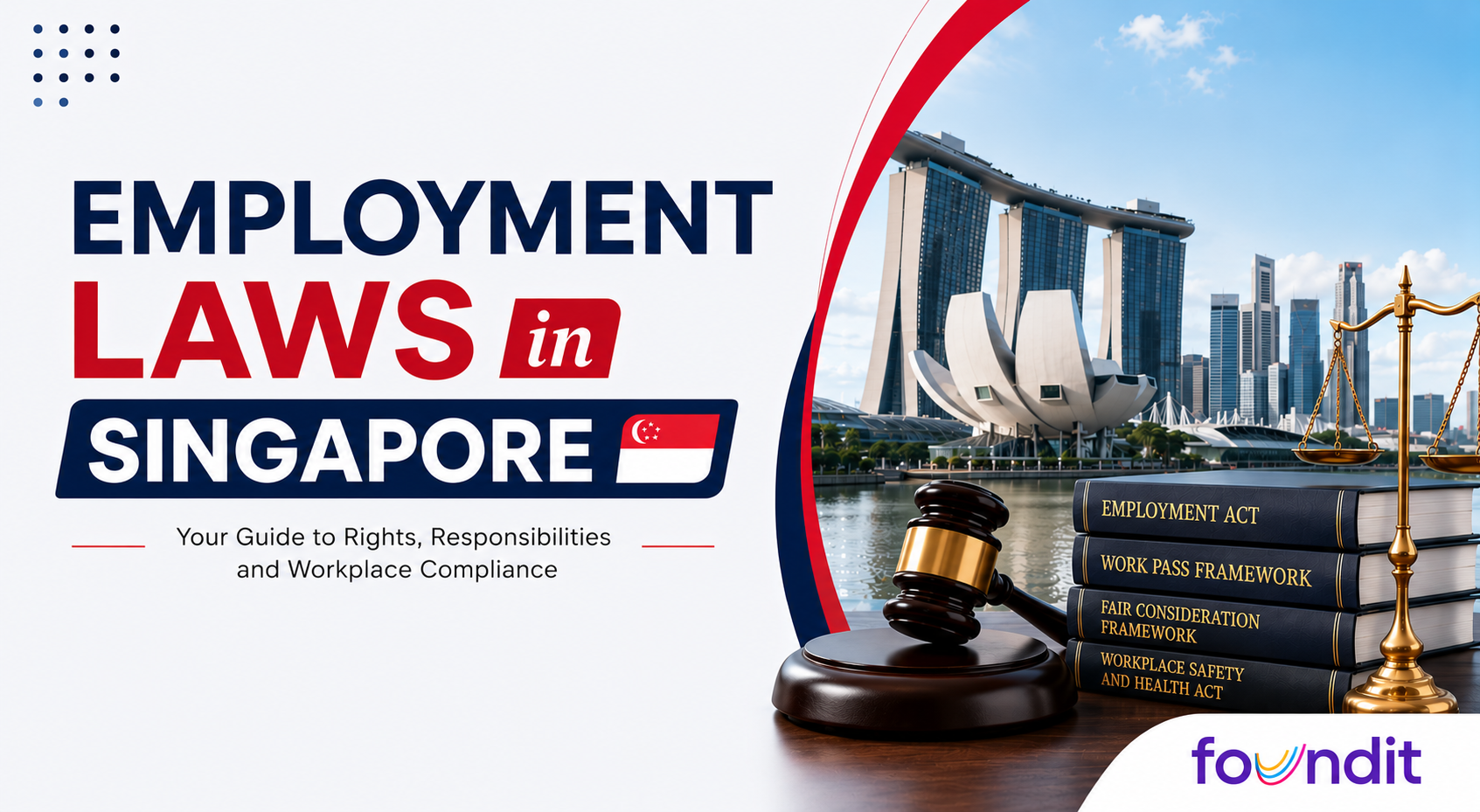
Employment laws in Singapore define the legal framework for employer–employee relationships, covering employment contracts in Singapore, wages, working hours, leave entitlements in Singapore, workplace safety, and termination rules.
The framework follows Ministry of Manpower Singapore guidelines and sets minimum employment standards, including salary payments, overtime rules, rest days, and basic workplace conditions.
Understanding workplace rights in Singapore helps ensure compliance with legal requirements and clarity in employment conditions.
Law 1: Employment Act (Core Employment Law)
Employment Act serves as the basis for employment laws in Singapore. It covers almost all the employees regardless of whether the employment is full time, part time, or contractual.
Primarily, the law concerns itself with salary payments, work hours, overtime, leave, and termination, among others. Essentially, this provides a benchmark against which the employment process will be measured.
While it covers all the above-mentioned aspects, not all roles get included. For instance, managers and senior employees do not qualify for overtime.
Key Rules under the Employment Act
- Salaries must be paid within seven days after the pay period
- Employees must receive written Key Employment Terms
- Overtime must be compensated where applicable
- Leave entitlements must meet minimum standards
- Termination must follow agreed notice periods
Many times, issues here are less about non-compliance and more about how roles are interpreted or classified.
Law 2: Employment of Foreign Manpower Act
A significant portion of Singapore’s workforce consists of foreign employees. Estimates suggest that around 30–35% of workers are non-residents.
The Employment of Foreign Manpower Act regulates how these employees are hired and managed. It covers work passes, quotas, levies, and employer responsibilities.
Compliance does not end with getting approvals in place. Employers are expected to meet ongoing requirements throughout the employment period.
Many times, gaps appear after hiring, when tracking and documentation are not handled consistently. This is where having clear internal processes makes a difference.
Key Rules for Employers
- Valid work passes must be secured before hiring
- Quota limits must be followed based on sector
- Levies must be paid where applicable
- Welfare and accommodation rules must be met for certain roles
Basically, the act requires ongoing attention rather than a one-time check.
Law 3: Workplace Safety and Health Act
The Workplace Safety and Health Act focus on occupational health and safety, particularly in industries with higher workplace risks.
Employers are required to identify workplace hazards, implement preventive measures, and provide safety training to employees. The Act promotes a proactive approach where safety remains an ongoing responsibility.
Over the years, Singapore has recorded improvements in workplace safety outcomes. A reduction in workplace injuries reflects the importance placed on maintaining safe working environments.
Workplace safety extends beyond compliance requirements. Safety principles are integrated into daily operations and organisational culture.
Apply for Workplace Safety and Health Act
Key Safety Requirements
- Conducting regular risk assessments to identify and address workplace hazards.
- Providing safety training to employees to promote safe work practices.
- Maintaining equipment in accordance with established safety standards.
- Reporting workplace incidents and reviewing them to prevent future occurrences.
Organisations that fail to meet safety requirements may face penalties and regulatory action
Law 4: Industrial Relations Act
The Industrial Relations Act controls the interaction between employers, employees, and trade unions. Its application is more appropriate in bigger firms or those with trade unions.
The act offers established methods of negotiation and conflict management. This can prevent conflicts from becoming major problems.
Industrial conflicts in Singapore are not frequent, indicating the efficiency of the process. It facilitates a solution through discussion instead of conflict.
Key Areas Covered
- Recognition of trade unions to facilitate employee representation in workplace matters.
- Collective bargaining and collective agreements that establish employment terms and working conditions.
- Dispute resolution frameworks that help employers, employees, and trade unions address industrial conflicts effectively.
Many times, early communication prevents situations from turning into formal disputes.
Law 5: Workplace Fairness Act (Recent Development)
The Workplace Fairness Act reflects the growing emphasis on fairness and equality in the workplace. The Act promotes fair treatment of employees throughout different stages of employment.
The legislation aims to ensure that hiring decisions, promotion opportunities, and workplace conduct are based on fair and objective criteria. It also supports the creation of inclusive and respectful work environments.
As workplace diversity and employee rights receive increasing attention, the Act strengthens Singapore’s commitment to fair employment practices and greater accountability in the workplace.
Key Focus Areas
- Preventing discrimination in employment-related decisions and workplace practices.
- Promoting fair hiring and promotion processes based on merit and qualifications.
- Establishing clear grievance handling procedures for addressing workplace concerns.
- Strengthening accountability and consistency in workplace decision-making.
Basically, the act brings more structure and accountability into everyday decision-making.
Who is Covered Under These Laws
Most employees in Singapore fall under the Employment Act. This includes both local and foreign workers engaged under a contract.
However, certain groups such as domestic workers and public sector employees are not covered under this Act. They follow separate regulations.
Many times, there is an assumption that coverage is the same for everyone. In practice, it depends on the type of employment. It is worth confirming applicability early to avoid confusion later.
Employment Contracts and Key Terms
Employers are required to provide written Key Employment Terms. These outline the essential conditions of employment.
They typically include job responsibilities, salary, working hours, leave entitlements, and notice periods.
Generally, a large number of disputes arise from unclear contracts. Expectations are often assumed rather than documented. A clear contract, even if simple, tends to prevent most issues.
Important Contract Elements
- Job responsibilities
- Salary structure
- Working hours and overtime terms
- Leave policies
- Termination conditions
Clear workplace policies and procedures help prevent misunderstandings and disputes.
Apply for Employment Contract Roles
Salary, Working Hours, and Overtime
Salary must be paid at least once a month and within the required timeline. This is a strict compliance requirement.
Working hours vary depending on the role. Some employees are subject to limits, while others operate with more flexibility.
Overtime provisions apply mainly to non-managerial roles and are compensated at a higher rate.
Singapore does not follow a universal minimum wage system. Instead, it uses the Progressive Wage Model (PWM), which sets sector-specific wage requirements and links wage growth to skills development, productivity improvements, and career progression.
Key Rules
- Overtime pay is typically 1.5 times the base rate
- Rest days must be provided
- Salary deductions must follow legal limits
In practice, payroll compliance is important. Even small errors can lead to avoidable issues.
Employee Benefits and Leave
Employees are entitled to statutory benefits such as annual leave, sick leave, and public holidays in Singapore. Additional benefits, including maternity and paternity leave, apply based on eligibility.
Singapore observes 11 paid public holidays each year, which employers must provide. Many organisations offer additional benefits, but the statutory baseline must always be met.
Key Leave Rules
- Leave entitlement increases with service duration
- Sick leave requires medical certification
- Public holidays must be compensated
In practice, benefits often influence employee satisfaction more than expected.
Read Also: Leave Application for Office
CPF Contributions (Savings System)
The Central Provident Fund (CPF) is a mandatory contribution system. Both employer and employee contribute monthly.
These funds are used for retirement, healthcare, and housing needs. Contribution rates vary by age and can go up to 37% of wages.
CPF applies mainly to citizens and permanent residents. It forms an important part of overall compensation planning.
Termination of Employment
Employment can be terminated by either party, subject to contractual terms. Notice periods must be followed. If not, payment must be made instead. Termination must also be fair.
Many times, disputes arise from how termination is handled rather than the decision itself. Clear communication and proper documentation usually help avoid escalation.
Key Rules
- Follow the notice period requirements specified in the employment contract.
- Avoid wrongful dismissal by ensuring that termination decisions are lawful and justified.
- Provide final salary payments and any outstanding benefits within the required timeframe.
A fair and transparent termination process helps protect the interests of both employers and employees.
Employment Laws for Foreign Workers
Foreign employees in Singapore must hold valid work passes. Employers must follow quota limits and levy requirements. This is closely monitored.
Compliance requires ongoing tracking. Even minor gaps can lead to penalties. Many organisations manage this through structured internal systems.
Dispute Resolution System
Singapore follows a structured approach to resolving employment disputes. Most cases begin with mediation. If unresolved, they move to the Employment Claims Tribunal.
Many cases are settled at the mediation stage, which keeps the process efficient. This approach reduces both time and cost for all parties involved.
Apply for Dispute Resolution Roles
Compliance for Employers
Employers must meet basic legal obligations, including issuing contracts, paying salaries, and providing statutory benefits. They must also ensure CPF contributions are made where required and maintain proper records.
In practice, compliance is less about complexity and more about consistency. Many issues arise from small gaps that build over time.
Conclusion
Employment laws in Singapore are structured, practical, and consistently enforced. They provide a stable framework that supports fair employment practices and workplace harmony.
As workplaces continue to evolve, employment regulations are also being updated to address emerging challenges and changing workforce needs. A clear understanding of legal requirements helps employers maintain compliance while enabling employees to better understand their rights and responsibilities.
Knowledge of how employment laws apply in real workplace situations is essential for fostering productive and legally compliant employment relationships.
FAQs
Working rules in Singapore are set by the Employment Act. They cover salary, working hours, overtime, leave, and termination. Employers must follow these rules to ensure fair treatment of employees.
The 3-month rule usually refers to the probation period. During this time, both the employer and employee assess suitability. Notice periods are often shorter and based on the contract.
No. A 13th-month salary, commonly called the Annual Wage Supplement (AWS) in Singapore, is not mandatory by law. Employers are only required to pay it if it is stated in the employment contract, company policy, employee handbook, or a collective agreement.
The five types of labour are skilled, unskilled, semi-skilled, professional, and managerial. These are based on skill level and job role. They help define how work is organised.
 Beware of Scammers
