






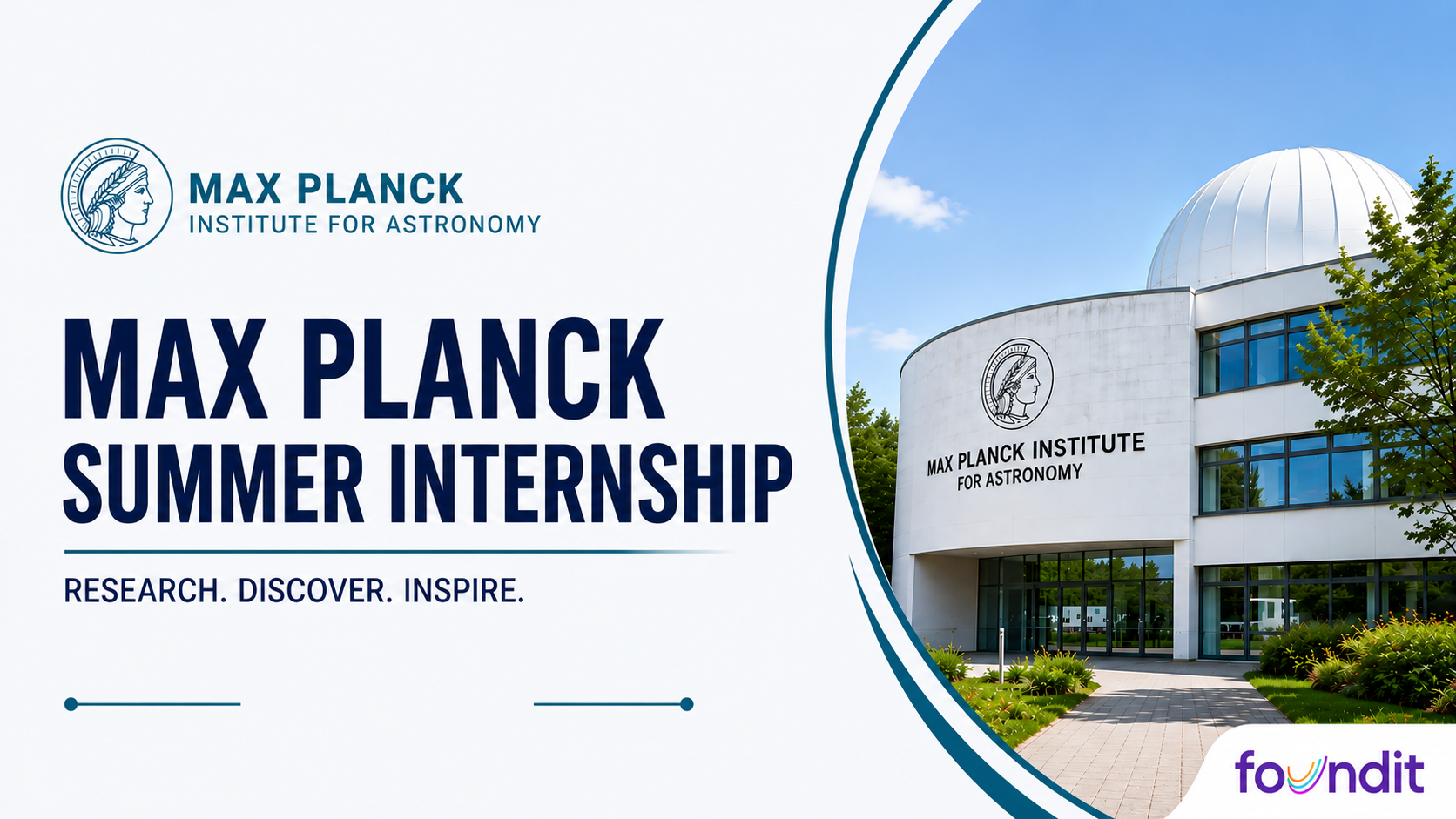
The Max Planck Summer Internship is a fully funded international research programme offered by the Max Planck Institute for Astronomy (MPIA), Germany. The programme provides bachelor’s and master’s students with an opportunity to work alongside leading researchers on astronomy and astrophysics projects while gaining practical research experience in a world-class scientific environment.
The Summer internship at Max Planck generally takes place between May and September and lasts for approximately three months. Selected interns receive a monthly salary, travel support, and social benefits, making it one of the most competitive research internships in Europe for students interested in astronomy and related fields.
Key Highlights
If you’re looking for a fully funded astronomy internship in Germany, here are the essential details.
| Particular | Details |
|---|---|
| Internship Name | Max Planck Summer Internship (MPIA Summer Internship) |
| Host Institute | Max Planck Institute for Astronomy (MPIA) |
| Location | Heidelberg, Germany |
| Internship Type | Research Internship |
| Mode | On-campus |
| Duration | Approximately 3 months |
| Internship Period | Typically between May and September |
| Eligibility | Bachelor’s and Master’s students from any country |
| Funding | Fully Funded |
| Monthly Support | Approximately €1,000 per month (net) with full social benefits |
| Travel Support | Provided by MPIA |
| Application Mode | Online |
About the Max Planck Summer Internship
The Max Planck Summer Internship is an international research programme organised by the Max Planck Institute for Astronomy (MPIA) in Heidelberg, Germany. It is designed for bachelor’s and master’s students who want to gain practical research experience by working on active astronomy and astrophysics projects under the guidance of MPIA scientists.
Unlike many short-term academic internships that focus primarily on training sessions or coursework, this programme places interns directly within research groups. Participants spend up to three months contributing to ongoing scientific research, data analysis, software development, simulations, or astronomical instrument development while working alongside researchers at one of Europe’s leading astronomy institutes.
The Max Planck internship is conducted entirely in English and is offered as an in-person programme at MPIA’s Heidelberg campus. Although the primary internship cycle is held during the summer months (typically between May and September), the institute also considers internship visits at other times of the year depending on academic calendars and supervisor availability.
MPIA also follows an inclusive selection approach. Besides academic excellence, the institute actively encourages applications from students belonging to groups that have traditionally been underrepresented in astronomy, including ethnic minorities, refugees or children of refugees, first-generation university students, and individuals with disabilities. Additionally, at least two internship positions are reserved for candidates from developing countries.
Related: UNICEF Internship Program
Research Areas
Rather than assigning every intern to a common project, MPIA allows applicants to choose research projects that closely match their academic background and interests. During the application process, students can select up to five preferred projects from the official list published for that year’s internship cycle. Final project allocation depends on the applicant’s qualifications, research interests, and the availability of supervisors.
The exact project list changes every year based on ongoing research at the institute. However, internship opportunities generally span a wide range of astronomy, astrophysics, computational science, and instrumentation topics.
Major Research Areas at MPIA
| Research Area | Examples of Internship Work |
|---|---|
| Exoplanets | Detection, characterisation, planetary atmospheres, and planetary system evolution. |
| Star Formation | Formation of stars, molecular clouds, circumstellar discs, and stellar evolution. |
| Planet Formation | Protoplanetary discs, dust evolution, planet-building processes, and numerical modelling. |
| Milky Way Studies | Galactic structure, stellar populations, nearby stars, and large astronomical surveys. |
| Galaxy Evolution | Formation and evolution of nearby and distant galaxies using observational data. |
| High-Redshift Universe | Research on quasars, early galaxies, and the evolution of the young universe. |
| Observational Astronomy | Analysis of telescope observations across X-ray, optical, infrared, and millimetre wavelengths. |
| Astronomical Simulations | Computer simulations of star formation, planet formation, galaxy evolution, and cosmology. |
| Astronomical Instrumentation | Development, testing, and optimisation of scientific instruments used on large international telescopes. |
| Scientific Computing | Programming, data processing, statistical analysis, visualisation, and software development for astronomy research. |
How Research Projects Are Assigned
Applicants are not randomly allocated to research groups. During the online application, candidates rank their preferred projects from the official project catalogue. After the initial screening, MPIA reviews each shortlisted applicant’s academic preparation, technical skills, research experience, recommendation letter, and interests before matching them with a suitable supervisor.
Choosing more projects—or selecting the same project multiple times—does not improve your chances of admission. Instead, applicants should carefully select projects that genuinely align with their academic background and future research goals.
Who Can Benefit the Most from These Research Projects?
- Students pursuing Astronomy or Astrophysics.
- Physics students interested in observational or theoretical research.
- Mathematics students working in computational or numerical sciences.
- Computer Science students with programming, simulation, or data analysis experience.
- Engineering students interested in scientific instrumentation and astronomical technologies.
- Students planning to pursue research-oriented master’s or PhD programmes in astronomy, astrophysics, or related disciplines.
Read Also: UNEP Internship
Documents Required
Applicants must submit all required documents through the online application portal. Incomplete applications or missing documents may not be considered during the evaluation process. Before starting the application, ensure that all supporting documents are prepared in the prescribed format.
| Document | Purpose |
|---|---|
| Curriculum Vitae (CV) | Summarises academic background, technical skills, research experience, projects, and achievements. |
| Statement of Motivation | Explains your research interests, preferred projects, and reasons for applying to the programme. |
| Academic Transcript | Shows courses completed and academic performance at your current university. |
| Recommendation Letter | A reference from a faculty member or academic supervisor who can evaluate your academic and research potential. |
Preparing a Strong Motivation Statement
The motivation statement is one of the most important parts of the application. Rather than describing general career goals, it should explain why you are interested in the specific MPIA research projects you selected and how your academic background prepares you to contribute to them.
A strong statement generally includes:
- Your current academic interests and area of study.
- The research topics or internship projects that interest you the most.
- Relevant coursework, technical skills, or research experience.
- Your long-term academic or research goals.
- How the internship aligns with those goals.
Read Also: Google Student Researcher Internship
Selection Process
The selection process at Max Planck is highly competitive because applications are received from students across the world. Each application is reviewed by MPIA researchers to identify candidates whose academic background and interests best match the available research projects.
| Stage | What Happens |
|---|---|
| Online Application | Candidates submit the application form along with all required documents. |
| Application Review | Research groups evaluate academic preparation, research interests, and supporting documents. |
| Project Matching | Eligible applicants are matched with suitable supervisors based on their preferred projects and qualifications. |
| Final Selection | Successful candidates receive an internship offer and further joining instructions. |
Applications are assessed on multiple factors, including academic performance, relevant coursework, technical skills, motivation, recommendation letters, and the suitability of the applicant for the selected research project. The institute does not publish a fixed cut-off score or minimum GPA for selection.
Related : InTent Internship Program
How to Apply
The application process is conducted entirely online through the Max Planck Institute for Astronomy’s internship portal. Applicants should carefully review the available research projects before completing the application form.
- Visit the official MPIA Summer Internship application page.
- Review the list of available internship projects for the current application cycle.
- Select up to five preferred research projects that match your academic background and interests.
- Prepare all required application documents, including your CV, motivation statement, academic transcript, and recommendation letter.
- Complete the online application form and upload the required documents.
- Review all information carefully before submitting the application.
- Wait for communication from MPIA regarding the outcome of your application.
Important Points to Remember Before Applying
- Select projects that genuinely match your academic preparation instead of choosing them at random.
- Read each project description carefully before adding it to your preference list.
- Submit all mandatory documents before the application deadline.
- Ensure that your recommendation letter is obtained from a faculty member who knows your academic work.
- Proofread your motivation statement and CV before uploading them.
Application Timeline
The Max Planck Summer Internship follows an annual application cycle. While the internship itself is generally conducted between May and September, applicants should always refer to the official internship page for the latest application opening dates, deadlines, and project listings, as these may vary from one year to another.
| Activity | Status |
|---|---|
| Application Mode | Online |
| Research Project List | Published on the official internship page for each cycle |
| Internship Period | Generally between May and September |
| Latest Deadline | Refer to the official MPIA application page for the current cycle |
Read Also: DAAD Scholarship
Why Choose the Max Planck Summer Internship?
The Max Planck Summer Internship offers much more than short-term research exposure. Interns become part of active research groups, work on real scientific problems, and collaborate with researchers who contribute to internationally recognised astronomy and astrophysics projects.
For students planning higher studies or research careers, the programme provides an opportunity to strengthen technical knowledge, gain practical research experience, and understand how scientific research is conducted in a leading international institute.
Key Advantages of the Programme
- Work on ongoing research projects instead of simulated assignments.
- Receive individual mentorship from experienced MPIA scientists.
- Collaborate with an international research community.
- Gain experience using professional scientific software, computational tools, and research methodologies.
- Develop practical skills in data analysis, programming, simulations, or astronomical observations depending on the assigned project.
- Build a stronger academic profile for future master’s, PhD, or research positions.
- Experience research at one of the Max Planck Society’s internationally recognised institutes.
- Live and work in Heidelberg, one of Germany’s major scientific and university cities.
Related: Japan Research Fellowship
Who Should Apply?
The Internship programme Max Planck is particularly suitable for students who want to pursue research-oriented careers after graduation. Applicants with a genuine interest in scientific discovery and a willingness to contribute to ongoing research projects are likely to benefit the most from this internship.
You should consider applying if you are:
- A bachelor’s or master’s student in astronomy, astrophysics, physics, computer science, mathematics, engineering, or a related discipline.
- Interested in pursuing postgraduate studies or a research career.
- Looking for international research experience before completing your degree.
- Comfortable working in a collaborative academic environment.
- Interested in computational research, scientific programming, observations, simulations, or instrument development.
Conclusion
The Max Planck Summer Internship is a valuable opportunity for students who want to experience research at an internationally recognised institute while working alongside leading scientists in astronomy and astrophysics. With financial support, access to advanced research facilities, and mentorship from experienced researchers, the programme enables participants to develop practical research skills in a collaborative academic environment.
Since admission is competitive, applicants should prepare a well-structured application, select research projects that closely match their academic background, and submit all required documents before the application deadline.
FAQs
Yes. Selected interns receive approximately €1,000 per month (net), social benefits, and financial support for travel expenses as specified by the institute.
Bachelor's and master's students from universities worldwide can apply, provided their academic background is relevant to the available research projects.
The internship takes place at the Max Planck Institute for Astronomy (MPIA) in Heidelberg, Germany.
The programme generally lasts for approximately three months and is usually conducted between May and September.
No. The internship is conducted in English, so applicants are expected to have a good command of English for research and communication.
Previous research experience can strengthen an application, but it is not stated as a mandatory eligibility requirement. Academic preparation, motivation, and suitability for the selected project are also important factors.
Yes. During the application process, applicants can select up to five preferred research projects from the official project list. Final allocation depends on project availability and the applicant's academic profile.
 Beware of Scammers
