
Privilege Leave refers to earned leave credited to employees by an organization over time. These leaves can be used for vacations, rest and recovery, marriage, or medical emergencies.
Since Privilege Leaves are meant for long-term absences, employees are usually required to apply for a minimum of three days, typically 7–14 days in advance, depending on company policy.
This article explains the privilege leave meaning in simple terms and walk you through the complete application process. Learn how to apply for privilege leave, the steps involved, and the common formats employers expect.
What are Privileged Leaves?
Privilege leave, also known as earned leave (EL), is a type of paid time off that employees earn based on their service with an organisation. The privilege leave meaning refers to planned leave used for vacations, family events, or personal reasons, and it usually requires advance approval through a privilege leave application. Unused privilege leave may be carried forward or encashed, depending on company policy and labour laws.
Privilege leave is meant for advance planning employees are usually required to submit a privilege leave application and obtain formal approval before taking the leave.
In many companies, unused privilege leave can be carried forward to the next year, depending on company policy and applicable labour laws.
Who is Eligible for a Privilege Leave in Organisation?
The entitlement to this leave is usually based on the company’s policy. While criteria can vary between companies, here are some common factors that determine eligibility:
- Tenure: Many companies grant employees privileged leave based on their service length.
- Employment Type: Full-time permanent employees will often be more qualified for privilege leave than part-timers and temporary staff.
- Work Status: Some companies might have special rules for various staff types, like probationers and those on leave of absence.
- Company Policy: Employers set up leave policies, and eligibility differs greatly. Eligible employees should consult the policies of their organisations concerning this Leave.
- Accrual Period: Privilege leave accumulates for a specified time annually for some employees. This can take months or even years.
- Performance: In certain situations, the right to privileges could be granted solely for high-performing employers.
How to Apply for Privilege Leave?
Applying for privilege leave is typically a straightforward process. Here are the steps to follow:
Step 1: Check Your Company’s Leave Policy
Before applying for privilege leave, review your company’s leave policy to understand the rules, eligibility criteria, and the maximum number of days you can avail.
Step 2: Determine the Duration
Decide on the duration of the leave you require, ensuring it aligns with your company’s policy.
Step 3: Inform Your Supervisor
Inform your immediate supervisor or manager about your intention to take privilege leave. It’s a good practice to provide ample notice.
Step 4: Complete the Leave Application
Obtain your HR department’s official leave application form or follow the digital process if available. Ensure all required fields are accurately filled.
Step 5: Specify the Reason
Clearly state the privilege leave reason in the letter. A transparent explanation is essential, whether for a vacation, personal reasons, or other purposes.
Step 6: Attach Supporting Documents
Depending on your company’s policy, you may need to attach supporting documents, such as travel itineraries, medical certificates, or family event invitations.
Step 7: Submit the Application
Submit your completed leave application to your HR department for processing. Ensure you adhere to the submission deadline, as specified by your company.
Step 8: Await Approval
HR or your manager will review your application and approve or deny it. You will receive a notification with the decision.
Step 9: Plan Your Leave
Once your leave is approved, plan your absence from work, ensuring a smooth transition of your responsibilities to a colleague, if necessary.
You May Also Like:
| Maximising Your Annual Leave | Sabbatical Leave Meaning |
| Medical Leave Application for Office | Sample Leave Application Letter and Writing Tips |
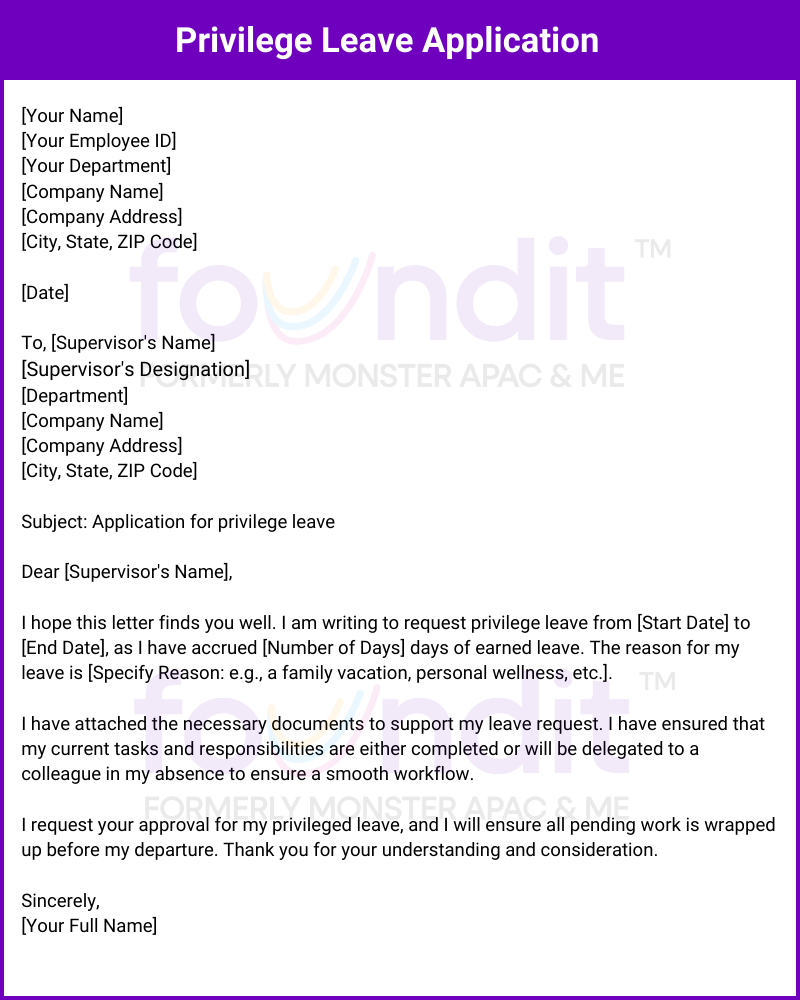
Privilege Leave Application Sample
Below is a letter/email sample on how to apply for a privilege leave:
Difference Between Privilege Leave vs Casual Leave
Here are the differences between a privilege leave vs casual leave in a tabular format:
| Aspect | Privilege Leave | Casual Leave |
| Purpose | Planned events, vacations, personal wellness, family events and relaxation. | Unplanned, immediate needs such as illness, emergencies, or personal emergencies. |
| Accrual | Earned over time based on tenure with the company. | Typically granted annually or monthly in fixed quantities. |
| Quantity | Often available in larger quantities and accumulates over time. | Usually limited to a smaller number of days, often not carried forward to the next year. |
| Approval Process | Requires advance planning and approval, often scheduled. | Can be requested with short notice and is subject to approval. |
Understanding the difference between privilege leave vs casual leave helps both employees and employers effectively manage leave policies and make informed decisions regarding time off.
Also Read:
| Paternity Leave Application | What is Bereavement Leave |
| Leave Application for Sister’s Marriage | Leave Travel Allowance (LTA) |
How does Privilege Leave Encashment Work?
Privilege leave encashment is a common HR practice that allows employees to encash unused earned or privilege leave based on salary structure and applicable tax rules.
- Privilege leave encashment refers to converting unused earned leave (also called privilege leave) into cash. This usually happens when an employee resigns, retires, or exits an organisation, though some companies also allow encashment at the end of the financial year, subject to internal policies.
- The privilege leave encashment amount is calculated based on the employee’s salary and the number of unused privilege leave days. The commonly used formula is:
(Basic Salary + Dearness Allowance) ÷ 30 × Number of Unused Leave Days.
- Privilege leave is accumulated gradually based on an employee’s length of service and company policy, rather than being granted all at once.
- Employees can choose to use privilege leave for planned time off or opt for privilege leave encashment, depending on eligibility and organisational rules.
- From a tax perspective, privilege leave encashment may be partially or fully exempt from tax, depending on specific conditions.
- In India, the tax treatment of privilege leave encashment is governed by Section 10(10AA) of the Income Tax Act, subject to prescribed limits and eligibility criteria.
Privilege Leave: What It Means to You
Privilege leave is a valuable benefit that provides employees with paid time off to maintain a healthy work-life balance, attend to personal matters, and enjoy well-deserved breaks. Understanding how to apply for this leave and adhering to your company’s policies ensures a hassle-free process that benefits you and your employer.
So, make the most of this employee privilege and create memorable moments during your well-deserved time off. Effective communication, planning, and complying with your company’s policies are the keys to a successful leave application. The privilege leave application samples available online for your reference, use them to make a professional image during your time off.
FAQs on How to Apply Privilege Leave
Q1. What is Privilege Leave, and How Does It Differ from Casual Leave?
Privilege leave means, the paid leave employees earn based on their tenure. It’s typically used for planned events. Casual leave, in contrast, is for unplanned or immediate needs and is often limited in quantity.
Q2. What Are Some Common Privilege Leave Reasons?
The privilege leave reasons may include vacations, family occasions, resting moments, and a personal break or vacation time.
Q3. How to Apply for a Privilege Leave?
To apply for privileged leave, follow these steps:
- Check company policy.
- Determine leave duration.
- Inform your supervisor.
- Complete the leave application.
- Specify the reason.
- Attach supporting documents.
- Apply for the leave and await approval.
- Plan your leave.
Q4. What Is Privilege Leave Encashment, and How Does It Work?
Unused earned leave days can be cashed out after an employee leaves through an entitlement known as privilege leave encashment. A corporate policy drives this functioning and can benefit employees financially.
Q5. What Does “Privilege Leave” Mean in the Context of Employee Benefits?
Privilege leave means offering paid leaves to employees, which they accumulate over time and use to achieve better work-life balance.
Q6. What is the Difference Between Casual Leave and Privilege Leave?
The difference between casual leave and privilege leave is that, casual leave is for unplanned, immediate needs like illness or emergencies, often limited and not carried forward. Privilege leave, earned over time, is for planned events like vacations, with larger quantities and accrual over tenure.
Related Articles: