

Becoming a dad is a life-changing moment—and if you're working in Singapore, knowing how to write paternity leave application can make things a whole lot smoother. While you’re entitled to two weeks of government-paid paternity leave under the Child Development Co-Savings Act, most companies still expect a formal paternity leave application.
Paternity leave allows employees to take time off after the birth of their child to support their family and manage early caregiving responsibilities. Submitting a well-written paternity leave application helps inform your employer in advance and ensures work responsibilities are planned during your absence.
Below in this article, you will learn the correct paternity leave format, how to write a professional paternity leave application email, and review practical paternity leave application samples that follow workplace policies.
What is Paternity Leave Application?
A paternity leave application is a formal request made by a male employee to seek approved time off for the birth or adoption of a child. It informs the employer about the leave period and helps plan work responsibilities during the employee’s absence.
Paternity Leave application usually includes paternity leave dates, employee details, and a brief reason for leave. Submitting a clear paternity leave application ensures benefits are processed correctly and allows the employee to support their partner and care for the newborn without work-related concerns
Importance of Paternity Leave
Paternity leave acknowledges the active role fathers play in early childcare and family well-being. Taking time off after the birth of a child supports both the family and the workplace in meaningful ways.
For the Family
- Strengthens family bonds: Paternity leave allows fathers to spend dedicated time with their newborn, supporting early emotional bonding.
- Supports maternal recovery: Fathers can assist with childcare and household responsibilities, reducing stress and aiding the mother’s physical and mental recovery.
- Improves child well-being: Shared caregiving in the early months contributes positively to a child’s health and development.
- Encourages shared responsibility: It promotes modern parenting by supporting equal involvement in childcare.
For the Workplace
- Promotes gender equality: Paternity leave reinforces the idea that caregiving is a shared responsibility, supporting balanced workplace policies.
- Boosts employee morale and retention: Organisations offering paternity leave often see higher job satisfaction and long-term employee loyalty.
- Attracts skilled talent: Fair parental leave policies make employers more appealing to a diverse and competitive workforce.
In India, eligible employees may receive up to 15 days of paternity leave under applicable service rules, reinforcing the importance of supporting new parents during this phase.
How to Write a Paternity Leave Application?
Adhering to the Paternity Leave Application Format helps streamline the process and provides clarity.
- Check company policy first: Review your organisation’s paternity leave rules, eligibility criteria, and required documents before applying.
- Use a clear subject line: Mention “Paternity Leave Application” along with your name and expected leave dates for clarity.
- State the reason briefly: Clearly mention the birth or adoption of your child as the reason for leave without adding personal details.
- Specify exact leave dates: Include the start date, end date, and total number of leave days you are requesting.
- Mention work handover: Briefly explain how your responsibilities will be managed during your absence.
- Maintain a professional tone: Keep the language polite, formal, and suitable for an official paternity leave application email.
- Close with a request for approval: End with a courteous line requesting approval and include a professional sign-off.
Paternity Leave Application Format & Template
| [Your Full Name] [Employee ID] [Department Name] [Date of Application] To, [Recipient’s Name] [Recipient’s Designation] [Company Name] Subject: Paternity Leave Application Dear [Recipient’s Name], I am writing to formally submit my paternity leave application as my partner is expecting our child. I would like to request leave to support my family during this important period. Expected Date of Child’s Birth: [Expected Date] Duration of Leave Requested: [Number of Days] Proposed Start Date of Leave: [Start Date] During my absence, I have made arrangements to ensure smooth work handover. [Briefly mention task delegation or coverage details.] I will complete all pending responsibilities before my leave and ensure continuity of work. I request you to kindly approve my paternity leave request. Thank you for your time and consideration. Yours sincerely, [Your Full Name] [Signature (if submitting a physical application)] |
You May Also Like:
| Annual Leave Application Letter | How to Write Casual Leave Application for Office |
| Leave Application for Sister’s Marriage | How to Write Leave Extension Letter |
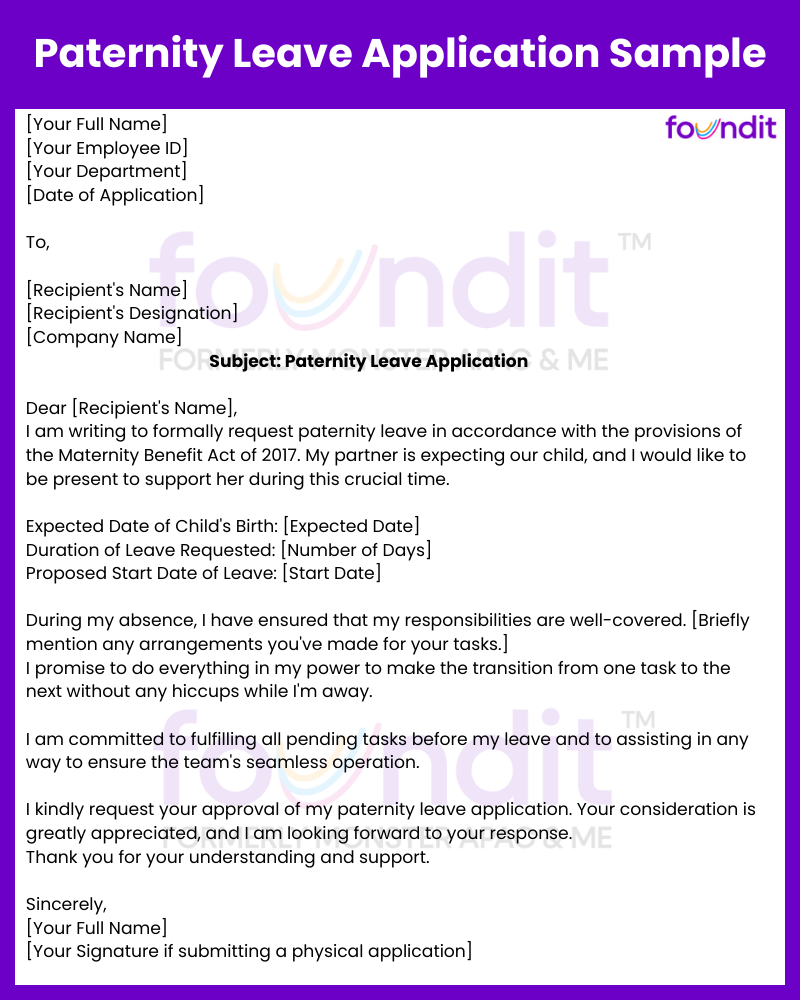
Paternity Leave Application Sample
[Your Full Name]
[Your Employee ID]
[Your Department]
[Date of Application]
To,
[Recipient’s Name]
[Recipient’s Designation]
[Company Name]
Subject: Paternity Leave Application
Dear [Recipient’s Name],
I am writing to formally request paternity leave in accordance with the provisions of the Maternity Benefit Act of 2017. My partner is expecting our child, and I would like to be present to support her during this crucial time.
Expected Date of Child’s Birth: [Expected Date]
Duration of Leave Requested: [Number of Days]
Proposed Start Date of Leave: [Start Date]
During my absence, I have ensured that my responsibilities are well-covered. [Briefly mention any arrangements you’ve made for your tasks.]
I promise to do everything in my power to make the transition from one task to the next without any hiccups while I’m away. I am committed to fulfilling all pending tasks before my leave and to assisting in any way to ensure the team’s seamless operation.
I kindly request your approval of my paternity leave application. Your consideration is greatly appreciated, and I am looking forward to your response.
Thank you for your understanding and support.
Sincerely,
[Your Full Name]
[Your Signature if submitting a physical application]
Paternity Leave Application Tips
Follow these paternity leave application tips for easy acceptance.
- Submit Early: Submit your application well in advance to give your employer ample time to plan for your absence.
- Be Clear and Concise: Clearly state your intention, dates, and reasons for the leave.
- Check Company Policies: Familiarise yourself with your company’s paternity leave policy to ensure accuracy in your application.
- Provide Relevant Information: If any documentation is required, ensure you attach it along with your application.
- Maintain Professionalism: Maintain a professional tone and gratitude throughout your application.
- Plan for Handover: Ensure that your responsibilities are well-covered during your absence.
- Follow Up: If you don’t receive a response, follow up to confirm the status of your application.
Also Read:
| Maternity Leave Application | Leave Application for Marriage |
| What is Privilege Leave? | What is Bereavement Leave |
Conclusion: Celebrating a Precious Moment
Writing a paternity leave application is not just a formal requirement but a heartfelt step to celebrate a significant life event. Through a well-structured application, you communicate your need for leave, commitment to responsibilities, and desire to support your growing family.
By adhering to the suggested format, using the sample as a guide, and following the provided tips, you can confidently submit an application that captures your professionalism and excitement about the forthcoming life journey.
As you write your paternity leave application, remember that you’re not just requesting time off; you’re embracing a pivotal role in your family’s story and nurturing a culture of support and balance in the workplace.
FAQs on Paternity Leave Application Sample
Q1. How Do I Structure a Paternity Leave Application?
Structure your paternity leave application with essential information: your name, ID, date, recipient’s details, and company. State your intent, expected due date, leave duration, start date, and task handover. Close formally.
Q2. What Should I Include in the Content of My Application?
In your application, include key details like the expected birth date, leave duration, and start date. Briefly mention reasons for paternity leave, like supporting your partner. Express your commitment to fulfilling responsibilities before and after your leave.
Q3. How Can I Maintain Professionalism in My Paternity Leave Application?
Maintain professionalism, use a respectful tone, and address the recipient formally. Express gratitude for their consideration. Clearly communicate your intent without oversharing. Emphasize your commitment to responsibilities and a smooth transition during your absence.
Q4. Should I Attach Any Documents to My Paternity Leave Application?
Attach any required documentation, like medical certificates, to your paternity leave request as per company policy. Check for any additional needed documents.
Q5. What Steps Can I Take to Ensure a Successful Paternity Leave Application?
For a successful paternity leave request, submit it well in advance, review your company’s policy, plan for task coverage, and follow up if needed.
Related Articles :