




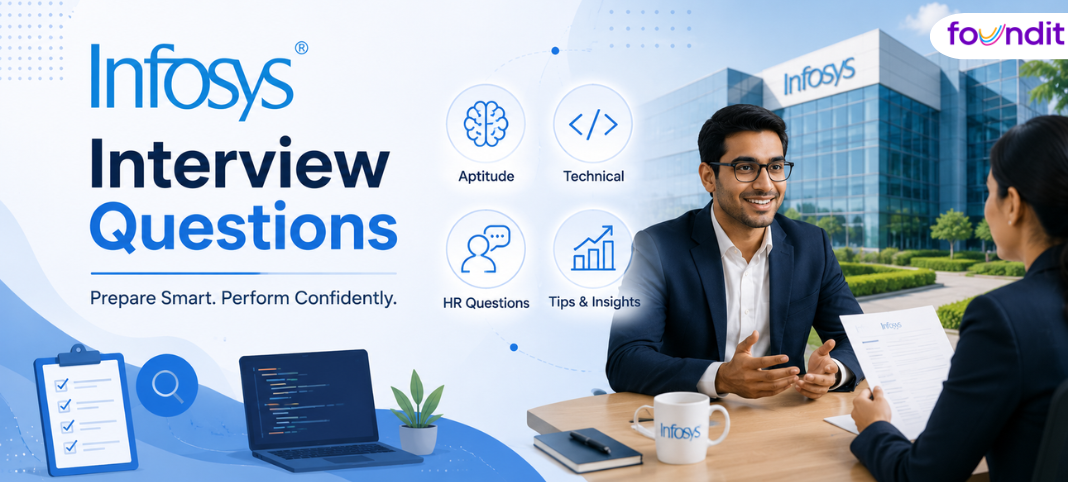
Infosys company interview questions usually cover both technical and HR areas. These questions test the candidate’s ability to comprehend basic principles and their capacity to communicate them.
While this may seem like a simple case of providing the right answer, in many instances, the actual test lies in the coherence of the explanation itself. As a matter of fact, interviewers give preference to clarity rather than complexity. This article covers some commonly asked technical and HR questions discussed during Infosys interviews.
About Infosys
Infosys is one of the world’s leading IT services and consulting companies, with a strong presence in Singapore and across Southeast Asia. Founded in 1981, the company offers services in software development, cloud computing, digital transformation, cybersecurity, and business consulting.
In Singapore, Infosys has expanded its regional operations through partnerships and digital transformation initiatives. The company strengthened its local presence through Infosys Compaz, a joint venture with Singapore-based Temasek focused on cloud, AI, and cybersecurity solutions.
Infosys serves clients across industries such as banking, healthcare, retail, manufacturing, telecommunications, and insurance. Singapore plays an important role in the company’s Southeast Asian operations due to its growing demand for digital innovation and enterprise technology services.
The company also hires fresh graduates and early-career professionals in Singapore through campus recruitment and off-campus hiring programs. Infosys generally looks for candidates with strong technical knowledge, analytical thinking, and problem-solving skills.
Infosys Interview Process and Evaluation Criteria
The Infosys interview process generally includes multiple stages designed to evaluate both technical knowledge and communication skills. Depending on the role, the selection process may vary slightly, but the overall structure remains fairly consistent.
Here’s how the interview process is usually structured:
| Interview Stage | What Is Evaluated |
| Online Assessment | Aptitude, logical reasoning, verbal ability, problem-solving |
| Technical Interview | Programming concepts, DBMS, OOPs, projects, coding logic |
| HR Interview | Communication skills, confidence, teamwork, adaptability |
| Managerial Discussion | Practical thinking, decision-making, professional behaviour |
In many cases, interviewers focus not only on the final answer but also on how clearly a candidate explains the thought process. Structured explanations and strong fundamentals often create a better impression than memorised responses.
Aptitude Assessment Breakdown
The aptitude assessment is usually the first stage of the Infosys recruitment process. This round evaluates a candidate’s analytical thinking, mathematical ability, logical reasoning, and communication skills.
The assessment commonly includes the following sections:
| Section | Topics Commonly Covered |
| Quantitative Aptitude | Percentages, profit and loss, probability, time and work, ratios |
| Logical Reasoning | Coding-decoding, puzzles, series, data interpretation |
| Verbal Ability | Grammar, sentence correction, reading comprehension |
| Pseudo Code | Basic programming logic and flow understanding |
| Puzzle Solving | Analytical and scenario-based problem-solving |
Candidates who perform well in the aptitude round are generally shortlisted for technical and HR interviews.
Eligibility Criteria
Candidates applying for Infosys interviews are generally expected to meet certain academic and recruitment eligibility requirements. These criteria may vary slightly depending on the role and hiring process.
Common eligibility requirements include:
- Minimum credits or equivalent GPA in O-Levels and A-Levels or polytechnic diploma
- Minimum 60% marks or 6.0 CGPA in graduation
- Basic understanding of programming concepts and computer fundamentals
- Good communication and problem-solving skills
- No major active backlogs during the recruitment process
For technical roles, candidates with knowledge of programming languages, DBMS, OOPs, operating systems, and computer networks are usually preferred.
Top Infosys Company Interview Questions
The overall structure of Infosys interview process is fairly predictable. You’ll see questions from OOPs, C/C++, data structures, DBMS, and a bit of networking.
But here’s what often gets missed. In many cases, even a straightforward question is answered by several levels of explanation. Thus, rather than hurrying with the explanations, it is better to approach gradually with a slower pace.
OOPs (Object-Oriented Programming)
What is an object in oops?
An object is an instance of a class. It carries data along with the functions that operate on that data.
In practice, this is what helps break large systems into manageable pieces. Instead of writing one long block of logic, everything is divided into smaller, self-contained units.
Take a simple example. In an e-commerce app, a “Cart” object holds items and also knows how to calculate the total. That connection between data and behaviour is what makes objects useful.
What is a class in oops?
A class is basically a blueprint for creating objects. It defines what an object will contain and how it will behave.
Many times, the way classes are designed ends up shaping the entire application. A clean class structure makes future changes much easier.
For instance, a “Customer” class might define name, email, and phone number. Every user in the system becomes an object built from that same structure.
- Minimum credits or equivalent GPA in O-Levels and A-Levels or polytechnic diploma
- Minimum 60% marks or 6.0 CGPA in graduation
- Basic understanding of programming concepts and computer fundamentals
- Good communication and problem-solving skills
- No major active backlogs during the recruitment process
For technical roles, candidates with knowledge of programming languages, DBMS, OOPs, operating systems, and computer networks are usually preferred.
Top Infosys Company Interview Questions
The overall structure of Infosys interview process is fairly predictable. You’ll see questions from OOPs, C/C++, data structures, DBMS, and a bit of networking.
But here’s what often gets missed. In many cases, even a straightforward question is answered by several levels of explanation. Thus, rather than hurrying with the explanations, it is better to approach gradually with a slower pace.
OOPs (Object-Oriented Programming)
What is an object in oops?
An object is an instance of a class. It carries data along with the functions that operate on that data.
In practice, this is what helps break large systems into manageable pieces. Instead of writing one long block of logic, everything is divided into smaller, self-contained units.
Take a simple example. In an e-commerce app, a “Cart” object holds items and also knows how to calculate the total. That connection between data and behaviour is what makes objects useful.
What is a class in oops?
A class is basically a blueprint for creating objects. It defines what an object will contain and how it will behave.
Many times, the way classes are designed ends up shaping the entire application. A clean class structure makes future changes much easier.
For instance, a “Customer” class might define name, email, and phone number. Every user in the system becomes an object built from that same structure.
What are the four basic principles of oops?
The four principles are encapsulation, abstraction, inheritance, and polymorphism.
Encapsulation keeps data protected within a class. Abstraction hides unnecessary details. Inheritance allows one class to reuse another’s features. Polymorphism allows the same method to behave differently in different contexts.
In practice, these ideas aren’t just theoretical. They’re used daily. For example, a payment system can support cards, UPI, and wallets using the same interface, while the internal logic remains separate.
Can we implement multiple inheritance in java?
Not directly through classes. Java avoids multiple inheritance there to prevent ambiguity.
However, it does allow multiple inheritance through interfaces. That’s the common workaround, and it’s widely used.
For example, a class can implement both “Printer” and “Scanner” interfaces. It gets features from both, without the confusion that class-based inheritance might create.
How is method overloading different from method overriding?
Method overloading means having the same method name with different parameters. Method overriding means redefining a method in a subclass.
In simple terms, overloading improves flexibility, while overriding adjusts behaviour.
For example, a calculate() method might take different inputs in one case, and in another, a subclass might change how that calculation is done entirely.
What is a constructor?
A constructor is a special method that runs when an object is created. It sets initial values.
In practice, this avoids incomplete or invalid objects. Everything starts in a known state.
For instance, when creating a “User”, the constructor might assign a default role or status automatically.
What do you mean by access specifiers?
Access specifiers define who can access certain data or methods. Common ones are private, public, and protected.
This is quite important in real projects. It prevents unnecessary exposure of data.
For example, account balance in a banking system is kept private. It can only be accessed through controlled methods.
What is inheritance? Name its types.
Inheritance allows one class to use properties and methods of another. It reduces repetition.
Types include single, multilevel, hierarchical, and hybrid inheritance.
A simple example would be an “Employee” class extended by “Manager”. The manager inherits common features and adds its own.
Read Also: Top 8 OOPS Interview Questions and answers
C and C++
What is a preprocessor in C/C++?
A preprocessor handles code before compilation. It processes directives like file inclusion and macros.
In practice, it helps organise code better and avoids repetition.
For example, #include is used to bring in standard libraries.
Why do we use Stdio.h in a program?
Stdio.h provides input and output functions.
Without it, basic operations like displaying results or taking user input won’t work.
For instance, printf() is used to print output on the screen.
What is a NULL pointer in C?
A NULL pointer points to nothing. It does not reference any valid memory location.
Many times, it’s used as a safe starting value. It avoids accidental access to unknown memory.
What is a pointer on a pointer?
This is simply a pointer that stores the address of another pointer.
It may sound abstract, but it’s useful in advanced memory handling and dynamic structures.
What is the difference between local and global variables in C?
Local variables exist within a function. Global variables are accessible throughout the program.
| Features | Local Variables | Global Variables |
| Scope | Accessible only within the function where they are declared | Accessible throughout the program |
| Preference | Preferred for better control and easier debugging | Used when multiple functions need shared access |
What is the use of return 0?
Return 0 indicates that the program has been executed successfully.
It’s a small detail, but it’s a standard convention across C and C++ programs.
Explain pointers in C++
Pointers store memory addresses. They allow direct access to data.
This becomes useful when working with large data. Instead of copying values, the program works with references.
What is the difference between an array and a pointer?
An array stores multiple values of the same type. A pointer stores the address of a variable.
Arrays are straightforward. Pointers are more flexible but require careful handling.
Data Structures
Give examples of data structures in C++
Common data structures include arrays, stacks, queues, linked lists, trees, and graphs.
In practice, the choice of structure affects performance directly.
For example, stacks are used in undo operations, while queues handle tasks in sequence.
Read Also: Top 10 Data Structure Interview Questions and Answers
DBMS and SQL
What is a database management system (DBMS)?
A DBMS manages how data is stored and retrieved. It connects users with databases.
In practice, it ensures data remains organised and consistent.
For example, banking systems rely heavily on DBMS for transaction handling.
What are the advantages of DBMS?
A Database Management System (DBMS) offers several advantages that help organisations manage data more efficiently and securely. Some of the key benefits include:
- Improves data consistency across different systems
- Reduces data duplication and redundancy
- Enhances data security through controlled access
- Makes data retrieval faster and more organised
- Supports backup and recovery of important data
- Allows multiple users to access data simultaneously
What do you mean by Object-Relational DBMS?
ORDBMS combines relational databases with object-oriented features.
It supports more complex data structures and is useful in modern applications.
What is a database schema?
A schema defines how a database is structured.
It includes tables, relationships, and constraints. A clear schema keeps data organised.
What are DDL and DML commands in SQL?
DDL and DML are two important categories of SQL commands used for database management. While DDL commands define and manage the database structure, DML commands are used to handle and modify the actual data stored inside tables.
DDL commands are used to create, modify, or remove database objects such as tables, schemas, and indexes. These commands mainly control the structure of the database.
DML commands are used to insert, update, retrieve, and delete data within database tables. These commands mainly work with the actual records stored in the database.
Differentiate between TRUNCATE and DELETE
TRUNCATE removes all records quickly. DELETE removes selected records.
| Features | TRUNCATE | DELETE |
| Scope | Removes all records from the entire table | Removes selected rows based on conditions |
| Command Type | DDL (Data Definition Language) | DML (Data Manipulation Language) |
| Speed | Faster because it removes data directly | Slower because rows are removed individually |
| Rollback | Generally cannot be rolled back in many databases | Can usually be rolled back before commit |
In practice, TRUNCATE is used when the entire table needs clearing. DELETE is used when conditions apply.
Why is indexing useful in SQL?
Indexing in SQL is used to improve the speed and efficiency of data retrieval operations. It helps the database locate required records faster instead of scanning the entire table row by row.
When databases contain large amounts of data, searching without indexing can become slow and resource-intensive. Indexes create a structured reference for specific columns, which allows queries to access data more quickly.
Indexing is especially useful for:
- Frequently searched columns
- Filtering records using WHERE conditions
- Sorting data using ORDER BY
- Joining multiple tables
- Improving query performance in large databases
What are Left Outer Join and Right Outer Join?
Joins are used in SQL to combine data from multiple tables based on related columns. Left Outer Join and Right Outer Join help retrieve matching and non-matching records from tables.
Left Outer Join:
- Returns all records from the left table
- Returns matching records from the right table
- Displays NULL values when there is no match in the right table
- Commonly used when all records from the primary table are required
Right Outer Join:
- Returns all records from the right table
- Returns matching records from the left table
- Displays NULL values when there is no match in the left table
- Useful when all records from the secondary table need to be displayed
In practice, both joins are commonly used in reporting, data analysis, and database management tasks.
What is a stored procedure?
A stored procedure is a saved SQL query that can be reused. In practice, it reduces repetition and improves efficiency.
Read Also: Top SQL Interview Questions and answers
Computer Networks & Software Testing
What is the difference between a session and a socket?
A socket is a communication endpoint. A session represents ongoing interaction.
Both work together to enable communication between systems.
What is the difference between TCP and UDP?
TCP and UDP are communication protocols used for data transmission over networks. TCP focuses on reliable data delivery, while UDP prioritises speed and faster communication.
| Features | TCP | UDP |
| Full Form | Transmission Control Protocol | User Datagram Protocol |
| Reliability | Ensures reliable data delivery | Does not guarantee delivery |
| Speed | Slower due to error checking | Faster because of minimal checking |
| Connection Type | Connection-oriented | Connectionless |
| Error Checking | Includes error detection and recovery | Limited error checking |
| Data Order | Maintains data sequence | Data order may not be maintained |
| Common Usage | Web browsing, email, file transfer | Video streaming, gaming, live broadcasts |
What Is SDLC?
SDLC stands for Software Development Life Cycle. It defines the stages of building software.
It includes planning, development, testing, and maintenance.
What is the difference between white-box and black-box testing?
White-box and black-box testing are two commonly used software testing approaches. White-box testing focuses on internal code structure, while black-box testing focuses on application behaviour and output.
| White-Box Testing | Black-Box Testing |
| The tester understands the application’s internal code and structure | The tester does not need knowledge of the internal code |
| Mainly performed by developers and testers | Performed by testers, developers, and end-users |
| Requires more time and detailed analysis | Requires comparatively less time and effort |
| Test cases are created based on internal logic and code flow | Test cases are created based on functionality and user requirements |
| Also known as structural testing, clear-box testing, or code-based testing | Also known as functional testing, closed-box testing, or data-driven testing |
In practice, both testing methods are often used together to improve software quality, identify defects, and ensure complete application testing.
Read Also: Top 10 Software Testing Interview Questions and Answers
Infosys System Design Questions
How would you design a scalable user login system for millions of users?
A scalable user login system should be designed to handle high traffic, maintain fast response times, and ensure strong security. The system usually follows a layered architecture for better performance and reliability.
Key components of a scalable login system include:
- API Layer: All login requests should pass through APIs to manage authentication requests efficiently.
- Load Balancer: Traffic should be distributed across multiple servers to avoid overload and maintain system stability.
- Authentication Servers: Dedicated servers should handle user verification and login processing.
- Caching System: Session tokens or JWTs can be stored in tools like Redis to reduce repeated database calls and improve speed.
- Database Optimisation: Databases should use indexing and replication to support large-scale user access.
- Password Security: Passwords must be encrypted and hashed using strong algorithms such as bcrypt or Argon2.
- Rate Limiting: The system should restrict repeated login attempts to prevent brute-force attacks.
- Monitoring and Logging: Real-time monitoring helps detect failures, unusual activity, and performance issues quickly.
- Failover Support: Backup servers and redundancy mechanisms should be available to maintain uptime during failures.
In practice, scalability mainly depends on load balancing, caching, and distributed infrastructure, while security depends on encryption, authentication controls, and proper access management.
How do you ensure data consistency in a distributed microservices architecture?
Data consistency is difficult in distributed systems. Each service manages its own data.
Most systems use eventual consistency. Data may update slowly but becomes correct over time.
The Saga pattern helps manage multi-step transactions. If one step fails, earlier steps are reversed.
The outbox pattern is also used. Services send updates through message queues. Other services update their data.
Idempotency is important. It ensures repeated messages do not cause errors.
In practice, consistency depends on structured workflows and reliable messaging.
What are the trade-offs between monolithic and microservices architectures?
Monolithic and microservices architectures follow different approaches to application development.
| Features | Monolithic Architecture | Microservices Architecture |
| Initial Setup | Easier and faster to build in the early stages | More complex due to multiple independent services |
| Scaling | Difficult to scale specific components independently | Services can be scaled individually based on demand |
| Failure Impact | One failure can affect the entire application | Failure in one service usually does not affect others |
| Team Suitability | Better for smaller teams and simpler applications | Suitable for larger teams managing complex systems |
Read Also: Top 30 System Design Interview Questions and Answers
Infosys HR Interview Sample Questions
Preparing for an Infosys HR interview gets easier when it is basic, structured, and focused from the start. Candidates must provide a clear, organised explanation of their qualifications, experiences, and professional objectives.
Why do you want to join Infosys?
Sample Answer:
I want to join Infosys because of its strong reputation in the IT industry and its focus on innovation, learning, and employee development.
The company provides opportunities to work on diverse projects and improve both technical and professional skills. I also appreciate Infosys’s global work culture and structured training programs for freshers.
Tell me about yourself.
Sample Answer:
One thing not mentioned in my resume is my interest in teaching basic coding concepts to students in my local community.
This experience helped me improve my communication and problem-solving skills while also teaching me how to explain technical concepts in a simpler way.
What are your strengths and weaknesses?
Sample Answer:
One of my strengths is adaptability. I can quickly learn new technologies and adjust to changing work environments. I also work well in teams and remain calm during challenging situations.
As for weaknesses, I sometimes spend extra time reviewing my work to avoid mistakes. However, I have been improving my time management skills by setting deadlines and prioritising tasks more effectively.
Do you have any questions for us?
Sample Answer:
Yes, I would like to know more about the learning opportunities and training programs available for freshers at Infosys. I would also like to understand how teams usually collaborate on projects and what skills the company expects employees to improve during the initial years.
Are you comfortable working night shifts?
Sample Answer:
Yes, I am comfortable working night shifts if the role requires it. I understand that IT projects often involve global teams and different time zones. I am flexible with work schedules and focused on contributing effectively to the team and project goals.
Why should we hire you?
Sample Answer:
You should hire me because I have a strong understanding of technical fundamentals along with good communication and problem-solving skills. I am eager to learn, adaptable to new environments, and committed to contributing positively to the organisation and team projects.
Infosys Interview Process and Evaluation Criteria
The Infosys interview process usually includes an aptitude round, technical interview, and HR discussion. In some roles, coding or system-based assessments may also be included.
Many times, candidates focus only on technical preparation. In practice, Infosys also evaluates communication, clarity of thought, confidence, and problem-solving approach during discussions.
Here’s how the evaluation generally works:
| Interview Stage | What Is Evaluated |
| Aptitude Round | Logical reasoning, quantitative ability, verbal skills |
| Technical Interview | Programming basics, problem-solving, project understanding |
| Coding Round | Coding logic, optimisation, debugging approach |
| HR Interview | Communication, attitude, teamwork, career goals |
| Managerial Discussion | Decision-making, practical thinking, adaptability |
Note: Interviewers tend to like structured explanations more than memorised answers. Sometimes, even if the candidate doesn’t have the correct answer, a cool and logical answer may have a better impression.
Educational knowledge is more important than terms in technical rounds. For instance, instead of defining a concept, candidates can be asked to explain how they applied it to a project.
For freshers especially, consistency throughout the process becomes important. Clear fundamentals, steady communication, and confidence generally make a noticeable difference.
What Infosys Interviewers Usually Evaluate
Infosys interviewers generally look beyond direct answers. They try to understand how clearly a candidate thinks and explains concepts.
While it is important to be technically knowledgeable, many times it is as much a matter of communication and confidence as it is technical. Candidates are more likely to succeed if they give answers step by step.
Interviewers commonly evaluate these areas:
- Understanding of technical fundamentals
- Logical and analytical thinking
- Communication clarity
- Problem-solving approach
- Project knowledge and practical exposure
- Confidence during discussions
- Ability to work in teams
- Learning attitude and adaptability
Interviewers also observe the interviewee’s reactions during an interview. Even with only a partial answer, it is often better to explain it calmly, rather than darting to guess at complicated answers.
For HR rounds, responses are usually evaluated based on honesty and structure. Over-rehearsed answers can sometimes sound unnatural during conversations.
Basically, Infosys prefers candidates who can explain concepts clearly, think practically, and communicate professionally in real work situations.
Infosys Fresher Salary
The fresher salary at Infosys Singapore generally depends on the job role, skills, interview performance, and hiring process. In most cases, entry-level packages differ slightly between technical, support, and specialised roles.
Freshers at Infosys Singapore generally receive salary packages based on their role, skills, and hiring category. The approximate fresher salary structure is shown below:
| Salary Component | Estimated Amount |
| Average Annual Salary | SGD 52,000 per year |
| Estimated Monthly Take-Home Salary | SGD 3,800 – SGD 4,500 per month |
Disclaimer: The salary ranges mentioned above are approximate and may vary based on factors such as location, company, individual skills, educational background, and market demand. These figures are indicative of entry-level roles and should not be considered guaranteed compensation.
Common Mistakes Candidates Make in Infosys Interviews
One of the most common mistakes candidates make in Infosys interviews is trying to sound overly technical. In many cases, simple and clear explanations work far better.
Another issue is memorising answers without understanding the concept. Interviewers often ask follow-up questions, and this quickly exposes incomplete preparation.
Here are some mistakes frequently noticed during interviews:
| Common Mistake | Why It Creates Problems |
| Giving memorised answers | Responses sound unnatural |
| Ignoring basics | Fundamental questions carry high weight |
| Speaking too quickly | Reduces clarity and confidence |
| Weak project explanations | Makes practical exposure unclear |
| Lack of communication practice | Affects HR and technical rounds |
| Guessing answers aggressively | Creates confusion during follow-ups |
Many times, candidates also underestimate HR interviews. However, communication, attitude, and confidence are closely observed there as well.
Another practical issue is poor time management before interviews. Candidates often spend too much time on advanced topics while ignoring fundamentals like OOPs, DBMS, and SQL basics.
Worth noting, interviewers usually appreciate honesty. Admitting partial knowledge calmly is often better than forcing an incorrect explanation.
Conclusion
Preparation for Infosys comapny interview questions mostly depends on strong fundamentals and consistent practice. In many cases, interviewers focus more on how clearly a candidate explains concepts rather than giving overly complex answers.
Candidates who present logical and structured explanations generally perform better during technical and HR discussions. If a candidate is not selected, Infosys usually allows reapplication only after six months, making proper preparation even more important.
In summary, clear understanding, steady communication, and confidence can make a noticeable difference during Infosys interviews.
Infosys Interview Questions FAQ
Infosys interviews usually include aptitude, technical, coding, project-based, and HR questions. Interviewers mainly evaluate programming fundamentals, communication skills, logical thinking, and problem-solving ability.
Freshers generally need a minimum GPA or equivalent results in O-Levels, A-Levels or polytechnic diploma, and a recognised degree. Candidates are also expected to have basic programming and communication skills.
InfyTQ is an Infosys learning platform that helps candidates improve programming, aptitude, and technical skills through assessments, certifications, and practice-based learning modules.
InfyTQ is an Infosys learning platform that helps candidates improve programming, aptitude, and technical skills through assessments, certifications, and practice-based learning modules.
Infosys is generally known for its structured work environment, learning opportunities, teamwork culture, and employee training programs for freshers and experienced professionals.
The Infosys interview process is manageable for candidates with strong fundamentals, aptitude preparation, and good communication skills. Consistent practice and clear explanations usually improve interview performance.
Infosys placement generally includes three main rounds: an online aptitude assessment, a technical interview, and an HR interview. Some roles may also include coding or managerial discussions.
 Beware of Scammers
