




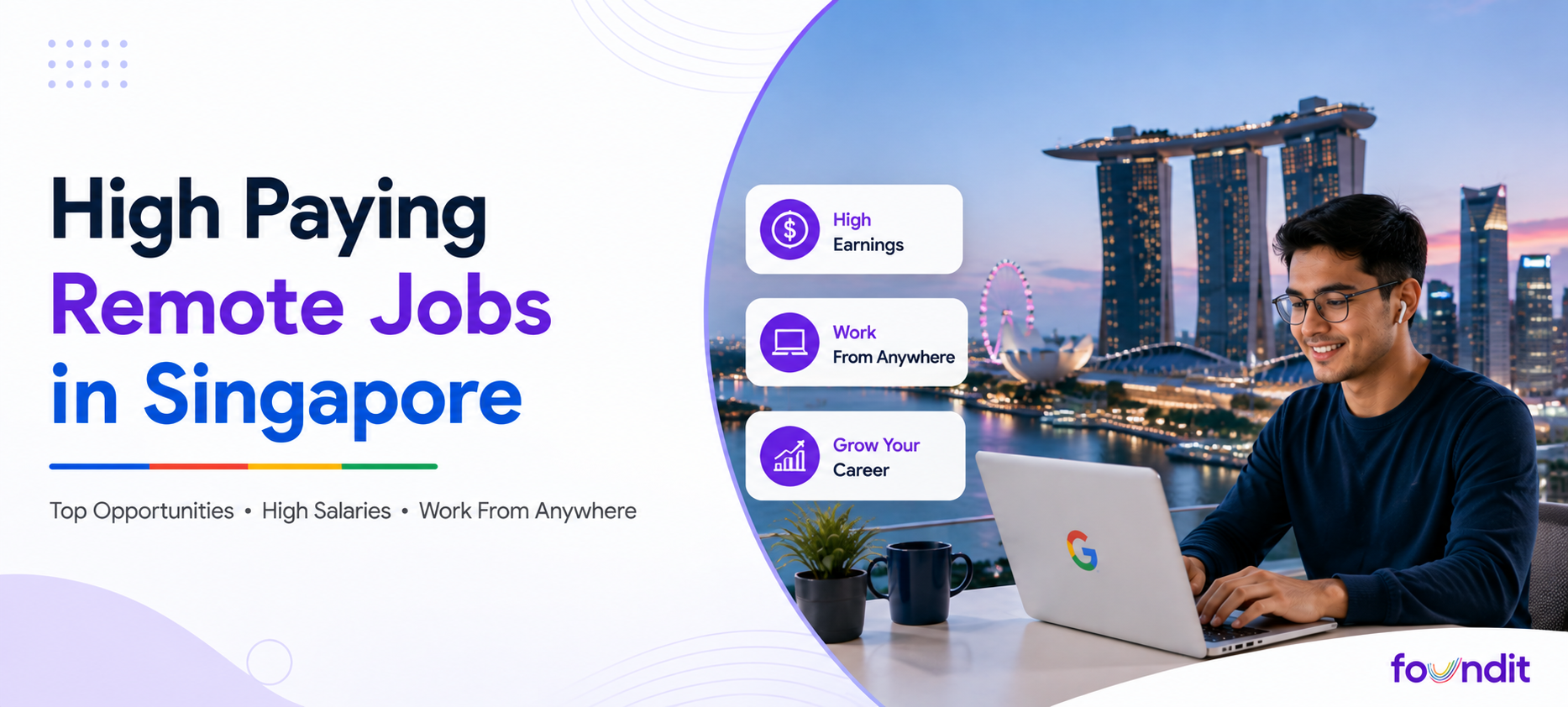
A high paying remote job is flexible, offers a better work-life balance, and pays well. It is considered by people nowadays.
According to Hays’ Asia Salary Guide 2025, 66% of professionals in Singapore work under hybrid arrangements. This trend illustrates that flexible working has become a typical practice across many businesses.
These days, a lot of businesses employ remote workers for positions in technology, finance, cybersecurity, and product management.
Experienced applicants with particular expertise frequently obtain higher compensation than experts in general business jobs.
This article showcases some of high paying remote jobs in Singapore. It also covers estimated pay, current recruiting trends, and practical strategies for securing these competitive jobs.
What Makes a Remote Job ‘High-Paying’ in Singapore?
High paying remote jobs in Singapore typically call for specialist knowledge and years of real-world experience. Employers pay more to professionals that solve business problems and contribute directly to company success.
Technology, finance, healthcare, and digital services offer many of Singapore’s best-paying remote positions. These sectors continue hiring talented experts because demand is higher than the available talent.
Singapore also supports flexible employment through its Flexible Work Arrangement guidelines. Many employers now provide hybrid or remote options where business operations allow.
Many work from home jobs Singapore employers offer competitive salaries to professionals with specialised technical and leadership skills.
The availability of skill is another crucial element. Robert Walters claims that companies are still struggling to fill jobs in digital transformation, cloud computing, cybersecurity, and artificial intelligence.
Top 12 Highest-Paying Remote Jobs in Singapore (With Salaries)
The average remote jobs Singapore salary depends on the role, industry, experience, and employer offering the position.
The estimated yearly salary for seasoned professionals in Singapore who work remotely or under hybrid arrangements are displayed in the table below.
| Role | Estimated Annual Salary (SGD) |
| Software Engineer / Full-Stack Developer | 75,000–110,000 |
| Data Scientist | 120,000 – 200,000 |
| Quantitative Analyst | 100,000–200,000 |
| Site Reliability Engineer (SRE) / DevOps Engineer | 120,000–160,000 |
| Product Manager (Digital / Fintech) | 104,150- 203,074 |
| Cybersecurity Specialist | 48,000- S140,000 |
| Performance Marketing Manager | 72,000–120,000 |
| Sales Director (Regional) | 185,862 |
| Legal Specialist (Tech / IP Law) | 65,000–400,000+ |
| UX / Product Designer | 48,000–150,000 |
| Cloud Solutions Architect | 70,000–216,000 |
| RegTech Analyst | 55,000–95,000 |
Disclaimer: Salary ranges for remote jobs in Singapore are approximate and based on available market data. Actual compensation varies by employer, experience, qualifications, and prevailing market conditions.
1. Software Engineer / Full-Stack Developer
Software engineers design, develop, and manage applications that support websites, business processes, and digital goods.
Professionals with strong programming, computer, and problem-solving abilities may find well-paying remote jobs in Singapore.
2. Data Scientist
To examine data, forecast trends, and enhance artificial intelligence-based decision-making, businesses employ data scientists.
Businesses in the retail, healthcare, finance, and technology sectors continue to have a significant demand for qualified AI specialists.
3. Quantitative Analyst
Quantitative analysts are employed by investment banks and fintech companies to create financial models, evaluate investment risks, and enhance trading tactics.
One of the highest-paying finance jobs in Singapore requires advanced mathematical, programming, and analytical skills.
4. Site Reliability Engineer (SRE) / DevOps Engineer
DevOps experts and site reliability engineers oversee cloud infrastructure, automate software deployment, and enhance system dependability.
Cloud platform firms often hire experienced engineers for remote and hybrid technology positions.
5. Product Manager (Digital / Fintech)
Product managers prioritise features, establish product strategy, and work with engineering, design, and business teams.
Businesses that provide remote fintech jobs in Singapore value experts that successfully supply digital solutions while balancing client wants with business objectives.
6. Cybersecurity Specialist
Cybersecurity professionals protect networks, cloud systems, and sensitive enterprise data from evolving security threats.
Growing security risks across the finance, healthcare, government, and technology sectors have increased demand for cybersecurity professionals in Singapore, making it one of the country’s most sought-after careers.
7. Performance Marketing Manager / Digital Marketing Lead
Performance marketing managers create digital activities that improve customer acquisition, engagement, and revenue growth.
Employers favour professionals with expertise in SEO, paid advertising, analytics, and marketing automation in both domestic and foreign markets.
8. Sales Director (Regional)
Regional sales directors oversee sales teams in several markets, handle important accounts, and create business strategy.
Competitive pay and performance-based incentives are frequently the outcome of having strong leadership, negotiating, and business planning abilities.
9. Legal Specialist (Tech / IP Law)
To handle intellectual property, business contracts, privacy laws, and compliance issues, technology businesses use legal experts.
As digital businesses expand into global markets, demand for professionals with expertise in technology and intellectual property (IP) law continues to grow.
10. UX / Product Designer
UX and product designers create digital experiences that improve user satisfaction and product usability.
Employers highly value professionals who combine user research, interface design, prototyping, and business understanding to build intuitive and effective products.
11. Cloud Solutions Architect
Cloud solutions architects provide scalable, safe cloud environments that serve contemporary corporate applications.
Businesses implementing digital transformation projects keep recruiting seasoned experts with knowledge of AWS, Microsoft Azure, and Google Cloud.
12. RegTech Analyst
Compliance analysts reduce operational and legal risks while assisting financial institutions in meeting regulatory requirements.
Understanding digital compliance systems, anti-money laundering techniques, and financial regulations expands one’s career prospects in Singapore’s booming fintech sector.
Read Also: 50 Best Ways to Make Money From Home 2026
Industries Actively Hiring Remote Talent in Singapore Right Now
Several sectors continue to grow their remote employment because specialised talent is difficult to find locally. Employers can acquire seasoned workers from larger sources of talent with the help of flexible hiring.
Singapore’s digital economy reached S$128.1 billion in 2024, or 18.6% of the nation’s GDP, according to the Infocomm Media Development Authority (IMDA). The increase shows how many different industries are in need of tech specialists.
Another LinkedIn research found that technology, financial services, and professional services were among Singapore’s top hiring industries over the last year, particularly for experienced workers.
Industries currently hiring remote talent include:
- Technology and Software Design: To support digital products and commercial apps, software organisations hire developers, software engineers, architects, and product specialists.
- Finance and Banking: Banks, insurance companies, and investment firms employ specialists in compliance, risk management, analytics, and financial technology.
- FinTech: Fintech firms are expanding their workforces as Singapore establishes itself as a key hub for financial technology.
- Cybersecurity: Businesses employ cybersecurity experts to defend digital infrastructure, customer data, and corporate systems against new threats.
- Cloud Computing: To handle contemporary platforms, businesses hire cloud architects, DevOps engineers, and infrastructure experts.
- Artificial Intelligence and Data Analytics: To optimise decision-making, automate procedures, and provide better customer experiences, businesses employ AI and data specialists.
- Digital Marketing and E-Commerce: Online businesses are seeking seasoned marketers that can manage customer acquisition and performance campaigns remotely.
- Professional Services: Knowledge-based jobs in consulting, legal, accounting, and advising businesses are increasingly using remote and hybrid work arrangements.
Read Also: Top 10 In-Demand Jobs for 2026
Skills That Command the Highest Remote Salaries in Singapore
Professionals that combine technical proficiency with business knowledge and effective communication skills are rewarded by employers. Building these skills improves access to highest paying remote jobs Singapore across multiple industries.
According to the World Economic Forum’s Future of Jobs Report 2025, 86% of employers expect AI and information processing technologies to transform businesses by 2030. This trend continues to increase demand for specialised digital skills.
The following skills consistently attract higher salaries:
- Cloud computing with Google Cloud Platform, Microsoft Azure, or AWS.
- Development of generative AI, machine learning, and artificial intelligence.
- Python, SQL, data analysis, and business intelligence technologies.
- Cybersecurity risk management and cloud security.
- DevOps, Docker, Kubernetes, and infrastructure automation.
- Agile project delivery and product management.
- Financial modelling and quantitative analysis.
- SEO, digital marketing, sponsored advertising, and analytics.
- Stakeholder management and cross-functional leadership.
- Outstanding abilities in distant collaboration and communication.
Professionals who regularly improve their technological skills tend to stay competitive in Singapore’s evolving job market.
Read Also: 8 tips to work effectively from home
How to Find and Land High-Paying Remote Jobs in Singapore
A focused job search and cautious planning are necessary to find a high paying remote job.
Candidates that exhibit technical expertise, communication abilities, and experience working independently are typically favour by employers.
Step 1: Build a Portfolio That Speaks for Itself
Compile projects, quantifiable accomplishments, credentials, and pertinent technical abilities into a portfolio. Whenever feasible, offer links to case studies, expert presentations, design portfolios, and GitHub repositories.
Additionally, candidates for technical roles should highlight their expertise in automation, cloud computing, or machine learning. Applications are frequently enhanced by a great portfolio prior to interviews.
Step 2: Match Your Job Platform to Your Target Role
Choose job platforms that specialise in your preferred industry instead of applying everywhere. Different platforms attract different employers and job opportunities.
- foundit Singapore: Technology, finance, marketing, and management roles.
- LinkedIn Jobs: Mid-level and senior professional opportunities.
- Jobstreet by SEEK: Local and regional vacancies.
- EFinancialCareers: Banking, investment, and fintech positions.
- Wellfound: Startup and technology companies.
- Remote OK and We Work Remotely: International remote technology opportunities.
According to LinkedIn’s Future of Recruiting Report, skills-based hiring continues to grow as employers place greater emphasis on practical capabilities than traditional qualifications.
Step 3: Signal Remote Readiness in Your Application
Candidates that can work independently and effectively collaborate with remote teams are highly valued by employers. It should be evident from your resume that you have experience working remotely or in a hybrid setting.
When necessary, introduce collaborative tools like Microsoft Teams, Slack, Jira, Notion, Trello, or Asana. Add accomplishments that demonstrate how projects were successfully finished in various locations or time zones.
Step 4: Negotiate Your Remote Salary Confidently
Before discussing wages with prospective employers, do some research on existing salary benchmarks. Candidates can negotiate reasonable packages that reflect their qualifications and expertise by being aware of market pricing.
In addition to basic pay, take into account the full benefits package. Overall pay is frequently increased by health insurance, bonuses, funds for professional growth, flexible scheduling, and annual leave.
Read Also: Remote Internship: Understand What is Remote Internship in Detail
Hybrid vs Fully Remote: What Singapore Employers Actually Offer
Many organisations embrace hybrid working because it combines workplace cooperation and employee flexibility.
Although they typically concentrate on specific technical or international roles, fully remote positions are still accessible.
Hays reported that 57% of professionals in Singapore worked under hybrid arrangements, making hybrid employment the most common flexible working model.
| Arrangement | % SG Employers / Workforce Trend | Typical Roles | Salary Premium | Key Platforms |
| Hybrid | Most organisations support hybrid work; around 66% of professionals work in hybrid settings (Hays) | Product Manager, Sales Director, Legal Specialist, Quantitative Analyst | Standard market salary with performance bonuses | Foundit, LinkedIn Jobs, Jobstreet |
| Fully Remote | More common for specialised digital and global positions | Software Engineer, Cloud Architect, Data Scientist, Cybersecurity Specialist | Often 5–15% higher for niche expertise and international employers | Wellfound, Remote OK, We Work Remotely |
Hybrid arrangements remain common across banking, consulting, legal, and corporate management positions.
Fully remote opportunities appear more frequently within software development, cybersecurity, cloud engineering, and digital product teams.
Conclusion
Remote employment has become an important part of Singapore’s professional workforce, especially across technology and financial services.
Experienced workers with technical and leadership abilities are still rewarded by employers.
Professionals, managers, executives, and technicians (PMETs) will continue to be the largest employment group, according to the Ministry of Manpower, demonstrating the ongoing need for knowledge-based positions throughout Singapore’s economy.
Professionals can increase their chances of landing high paying remote job in Singapore by investing in digital skills, industry certifications, and real-world experience.
FAQs
The highest paying remote jobs in Singapore include those of software engineers, quantitative analysts, cloud solutions architects, product managers, cybersecurity experts, and data scientists.
Depending on their role, experience, company, and industry, experienced professionals often make between SGD 95,000 and SGD 300,000 per year.
Hybrid workers split their working hours between the office and their homes. Workers that are fully remote carry out all of their responsibilities outside of their employer's office.
Yes, during hiring talks, candidates can bargain for a higher wage by bringing up pertinent experience, specialised skills, certifications, and current market salary benchmarks.
Remote workers are frequently hired by technology, financial services, fintech, cybersecurity, cloud computing, healthcare, professional services, and digital marketing
No. In general, remote workers adhere to Singapore's current income tax regulations. Rather than the place of employment, tax liabilities are determined by resident status, employment contracts, and applicable rules.
 Beware of Scammers
